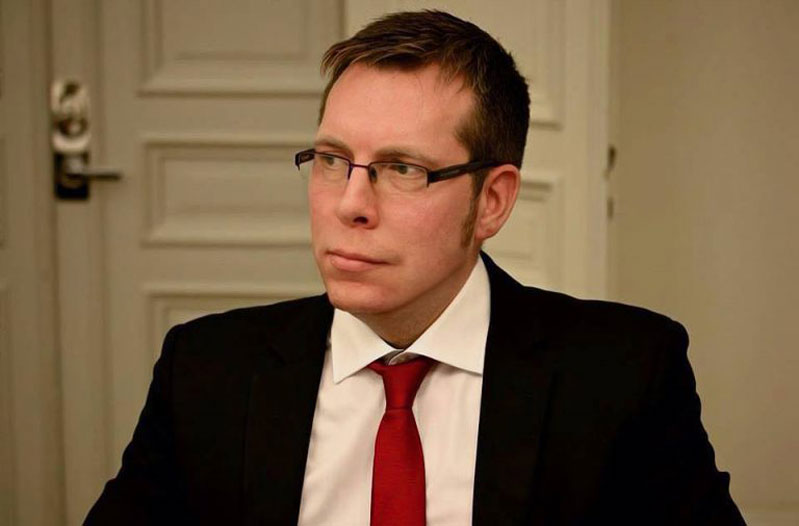




King Abode threatens Germans in his self-styled social media comments. Twitter

Germany’s most famous migrant shows how the state is failing

He is regarded as the German state of Saxony's best known asylum seeker: Mohamed Youssef T. He calls himself only "King Abode", and since his arrival in Germany, he has been keeping the police and justice on their toes.

Published: July 28, 2019, 11:16 am

    His “proud” record has been listed as over 60 cases of personal injury, property damage, theft, trespassing, drugs, insults and resistance to police officers. But the chances of getting the criminal migrant deported remain slim.

    The story of T. begins in 2014, when he arrived to Germany via Italy and Switzerland. After the revolution in Libya, his father and two brothers were killed by militia, Abode maintains. He was the only member of his family who had managed to escape.

    In Germany, he was finally assigned to the district of Bautzen. However, as early as September 2016, the authorities rejected his application for asylum. Due to various contradictory statements and the political situation – his home region, for example, was not threatened at all – the authorities saw no need to recognize the Libyan as a refugee.

    The next highest instance, the Dresden Administrative Court, confirmed the decision. Since then Abode has complained to all instances as well as causing non-stop trouble. He would either be implicated in stealing a cell phone, or indiscriminately bumping into a car door. At some point even the city of Bautzen got fed up with the troublemaker, and in August 2017, he was issued with a three-month stay ban.

    In the summer of 2016, there were heavy riots between migrants and Germans at the Bautzener Kornmarkt. Right in the middle of it all was none other than King Abode. In the months to follow, his criminal record expanded steadily.

    The Libyan terrorized the town for months resulting in persistent civil complaints after a series of assaults. He was transferred to an accommodation in Radeberg, but that did not suit him and he returned standing on the roof of the asylum home on the Flinzstrasse, pretending to be a victim of German authorities and threatened to jump.

    As the accommodation in Radeberg was closed, the residents were redistributed and his three-month residence ban expired. “At present, no renewed ban on residence is considered necessary for the person concerned,” explained Matthias Almert from the Bautzen Town Hall.

    His case has elicited international attention. One month after his ban on the city, journalists from the New York Times release a sentimental video in which they question him about the riots. His dubious justification was that “Germans” in Bautzen had attacked him repeatedly and even when he tried to call the police, the officials would not respond. So he had to take matters into his own hands, he claimed.

    The public prosecutor Dresden has launched several procedures against against the migrant since this attempt at emotional blackmailing. In one of the trials, he was fined 400 euros and his second imprisonment of eight months. But the judgment is not yet final, as Abode’s lawyer has already appealed.

    The remaining proceedings have been discontinued or handed over to the public prosecutor’s office Görlitz.

    But in Görlitz the perpetrator is no stranger either. There he faces at least 61 charges, nine of which went to court, according to authorities. The long list of micro-offenses had forced the city of Bautzen in September 2018 to impose a residence ban on him.

    This measure did not impress Abode much. In a shaky mobile phone video, which he took himself, he threatens authorities: “Police, I have no respect for you, I’ll fuck, fuck, fuck, fuck you! I will stay here in Germany.”

    But how can it be that someone like T. has not yet been deported? First of all, he has no passport. “The Libyan authorities have meanwhile signaled their participation in passport procurement measures through the assistance of the Center for the Support of Return,” reported the Saxony State Directorate when approached by Berlin weekly Junge Freiheit.

    The Libyan embassy is also trying to help. In spite of this, “the current security situation in Libya continues to suggest that a timely deportation will not be possible”. T. thus continues to live in his communal shelter in Kamenz – at the expense of the German taxpayer.

    On August 22, he will have to appear before the district court Bautzen again. The allegations range from several cases of personal injury, property damage, insult and trespassing.
    Consider donating to support our work

    Help us to produce more articles like this. FreeWestMedia is depending on donations from our readers to keep going. With your help, we expose the mainstream fake news agenda.

    Keep ​your language polite​. Readers from many different countries visit and contribute to Free West Media and we must therefore obey the rules in​,​ for example​, ​Germany. Illegal content will be deleted.

    If you have been approved to post comments without preview from FWM, you are responsible for violation​s​ of​ any​ law. This means that FWM may be forced to cooperate with authorities in a possible crime investigation.

    If your comments are subject to preview ​by FWM, please be patient. We continually review comments but depending on the time of day it can take up to several hours before your comment is reviewed.

    We reserve the right to del​ete​ comments that are offensive, contain slander or foul language, or are irrelevant to the discussion.

    No comments.

    By submitting a comment you grant Free West Media a perpetual license to reproduce your words and name/web site in attribution. Inappropriate and irrelevant comments will be removed at an admin’s discretion. Your email is used for verification purposes only, it will never be shared.

    Europe

    Berlin Ditches German Opera for Afrofuturism

    The Deutsche Oper in Berlin may still bear that name – but opera is a thing of the past.

    With Nordenskiöld Through the Northeast Passage

    In April, 1880, Stockholm's streets were filled with people cheering when a three-masted ship sailed into the harbour.

    Will Coalition of Ukraine Supporters Crumble without Macron?

    ParisMore than four and a half years after the outbreak of war in Ukraine, the coalition of the "willing" is showing cracks.

    Norwegian Police: Do Not Share Burglar Footage Without Criminals’ Consent

    In a controversial advisory that has sparked widespread public frustration, Norwegian police have urged residents not to share video recordings from their private security cameras that capture burglaries in progress.

    Italian Politics Sees Rise of New Right-Wing Force and Shifting Alliances

    Italian politics is witnessing rapid realignments, with a new right-wing party gaining momentum in just a few months and pro-Russia sentiments appearing to strengthen on both ends of the political spectrum.

    Czech Republic’s First Afro Politician Released Early After Rape Convictions ‘Changes’ Him

    With his Afro hairstyle and anti-racist message, Dominik Feri was predicted to become a political star who would shape the future of both the Czech Republic and Europe.

    Zelensky and Budanov’s New Population Exchange Plan: Solve Ukraine’s Demographic Collapse with Migrants

    Indians, Pakistanis and Africans are to replace the hundreds of thousands of Ukrainian men who have died at the front. In Kiev, liberalization is now being prepared to solve the labor crisis through immigration of a Western European nature – although corruption and the reluctance of migrants to stay in the war-torn country are still slowing down the population exchange.

    The Double Standards of the European Commission

    On June 26, 2026, in the midst of a historic heatwave hitting Europe, the European Commission headquarters in Brussels (Berlaymont) sent out a chilling internal message to its employees

    Germany Struggles to Enlist New Recruits

    A blow for the German Armed Forces: 300,000 questionnaires, but only 530 volunteers.

    Britain Starts Buying Russian Oil again

    While Keir Starmer and his Labour ministers continue to talk of “unwavering solidarity” with Ukraine and the need to “make Putin pay,” the British government has just surreptitiously signed a permit once again authorizing imports of Russian oil products.

    Go to archive