



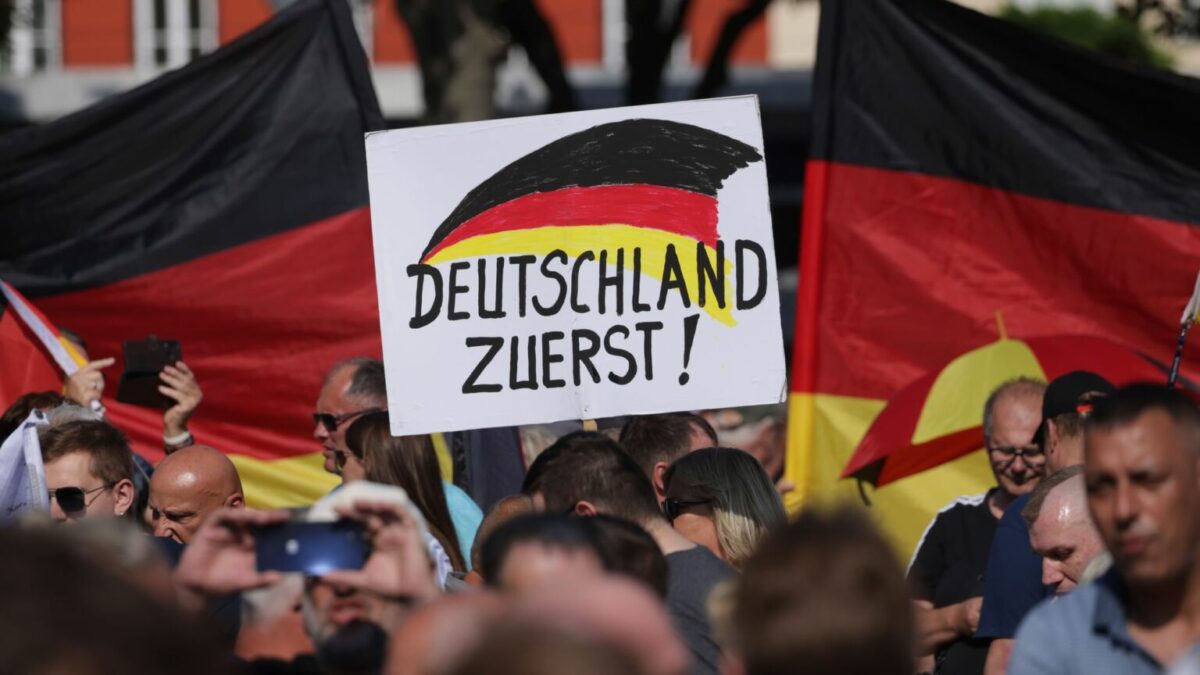
Germany first. Photo supplied

Latest AfD Victory Not a Blip But a Structural Shift

With 38.2 percent of the vote and a gain of more than 21 percentage points, the AfD did not merely win the Mecklenburg-Western Pomerania state election. It delivered a structural verdict on a political order that had treated a large part of the electorate as a problem to be managed rather than a public to be represented.

Published: September 21, 2026, 1:50 pm

    The party more than doubled its 2021 result of 16.7 percent, drawing in former non-voters and peeling support from across the established spectrum. Its lead over the SPD, which finished at 35.5 percent in a state long treated as a social-democratic redoubt, was narrow but decisive. After nearly three decades of SPD primacy, the largest party is now the one the other parties had spent years trying to isolate.

    The geography of the result matters as much as the headline. The AfD advanced in its familiar rural and small-town strongholds and posted high shares across much of the state. In some eastern districts it crossed 50 percent; in individual communities the figure approached 80 percent. This was not a localized protest confined to a few angry pockets. It was a statewide realignment. Turnout rose to 78.1 percent, well above the 70.8 percent of 2021. Higher participation usually favors incumbents when they still command trust. Here it favored the challenger. Political dissatisfaction was converted into organized support rather than into abstention or scattered protest votes.

    Leif-Erik Holm and the state campaign succeeded in framing the AfD as more than a vehicle for anger. They spoke directly to economic insecurity in a region that has lived with deindustrialization, out-migration, and the long tail of unification. They treated demographic change as a policy problem rather than a moral test. They treated crime and public order as legitimate concerns instead of coded language. And they offered a dissenting account of the war in Ukraine and its costs for German energy, industry, and living standards.

    A substantial share of voters concluded that the established parties no longer described their world accurately.

    This result does not stand alone. It follows a pattern of strong AfD performances across eastern Germany. The party now possesses a durable, mobilizable base in the former GDR states. That base is no longer a protest residual that appears in one election and evaporates in the next. It is an electoral fact. Established parties ran intensive campaigns, deployed incumbency advantages, and still lost contact with large segments of the public. The CDU’s collapse to 4.9 percent—and its first-ever failure to enter a state parliament—illustrates how brittle the old center has become when it cannot answer basic questions about security, energy prices, and social cohesion.

    Critics will insist the AfD remains a protest party whose gains will fade once “responsible” forces recapture the narrative but the numbers suggest otherwise. A party that more than doubles its vote, raises turnout, wins the plurality in a former SPD stronghold, and converts non-voters into supporters is performing the classic function of a catch-all opposition: aggregating grievances the incumbents have left unaddressed.

    Calling that “protest” is a way of refusing to examine why the protest is so large and so persistent.

    The firewall strategy has produced a paradox. By declaring the largest party illegitimate in advance, the other parties have turned every election into a referendum on exclusion itself. Voters who already feel talked down to hear that their preferred option is beyond the pale. To counter that, they showed up and voted for the excluded option. The AfD has become the beneficiary, a structural force that is permanently altering the political landscape of Mecklenburg-Western Pomerania.

    None of this guarantees the party will govern. The arithmetic and the cordon sanitaire still point toward an SPD-led coalition with the Left and Greens. That arrangement may keep the AfD out of office but it will not erase the 38 percent. A democracy that treats a first-place finish as a problem to be contained rather than a signal to be understood is advertising its own demise. The voters of Mecklenburg-Western Pomerania have already drawn their conclusion. The rest of the party system can keep repeating that they are wrong, or it can start asking why so many decided they were right.

    opinion@freewestmedia.com

    Exclusively for freewestmedia.com

    Consider donating to support our work

    Help us to produce more articles like this. FreeWestMedia is depending on donations from our readers to keep going. With your help, we expose the mainstream fake news agenda.

    Keep ​your language polite​. Readers from many different countries visit and contribute to Free West Media and we must therefore obey the rules in​,​ for example​, ​Germany. Illegal content will be deleted.

    If you have been approved to post comments without preview from FWM, you are responsible for violation​s​ of​ any​ law. This means that FWM may be forced to cooperate with authorities in a possible crime investigation.

    If your comments are subject to preview ​by FWM, please be patient. We continually review comments but depending on the time of day it can take up to several hours before your comment is reviewed.

    We reserve the right to del​ete​ comments that are offensive, contain slander or foul language, or are irrelevant to the discussion.

    No comments.

    By submitting a comment you grant Free West Media a perpetual license to reproduce your words and name/web site in attribution. Inappropriate and irrelevant comments will be removed at an admin’s discretion. Your email is used for verification purposes only, it will never be shared.

    Opinion

    The inflation hoax

    Yes, prices are rising, but not for the reasons the Federal Reserve says. When I say inflation is a hoax, I mean the purported cause is a hoax. The Fed is fighting a consumer inflation, a “demand-pull” inflation. But what we are experiencing is a supply-side inflation caused by the Covid lockdowns and economic sanctions that closed businesses, disrupted supply chains, and broke business relationships while reducing energy supplies to the UK and European countries, thus forcing up costs in a globalized economy.

    Two-Party Pox: The Republicans suck and the Democrats want to kill you

    The Republican Party has never stood up for Americans, will never stand up for them and is not going to do what it takes. Past is prologue.

    Russia’s loss at Kharkov highlights crippling shortage of men

    KharkovThe frontline in this case relied on heavily outnumbered 2nd rate Lugansk draftees plucked from the LPR.

    A country without an honest media is lost

    For some time I have reported to you that in place of a media, a media that our founding fathers relied on to protect our society, the United States has had a propaganda ministry whose sole purpose is to destroy our society.

    Sweden’s decaying democracy

    A journalist is arrested and dragged out of the Gothenburg Book Fair because he politely asked a powerful politician... the wrong questions about his support for the ethnically-cleansed Zimbabwean dictatorship. Not only journalists, but academics and bloggers are being hounded by the leftist establishment daily. And the leftists have all the nasty instruments of the state at their disposal. Citizen reporter Fabian Fjälling looks into their excesses.

    The geopolitical future of Nordic countries

    Between unity and disunity, independence and foreign interference: Nordic countries have to either choose between creating an independent neutral block in the North, or seeing the region being divided between the great powers.

    Russian, Chinese intelligence: ISIS heading for Central Asia with US cover

    Operatives of the crumbling Islamic State in Syria and Iraq (ISIS) are moving to new battlegrounds near the Russian border, intelligence sources have revealed.

    The unraveling of US/Russian relations

    Washington has taken nuclear war against Russia from a hypothetical scenario to a real danger that threatens the future of humanity. 

    Hero commander killed in Syria – when the war is nearly won

    For most Syrians it came as a shock: One of the most popular military commanders of the Syrian Arab Army, Issam Zahreddine, was killed on 18 October 2017.

    What Is The Obama Regime Up To?

    Obama has announced new sanctions on Russia based on unsubstantiated charges by the CIA.

    Go to archive